
Wild Leadership in the Age of AI
A Wild Leadership view on technology, judgement, and why the future of work belongs to stewardship.
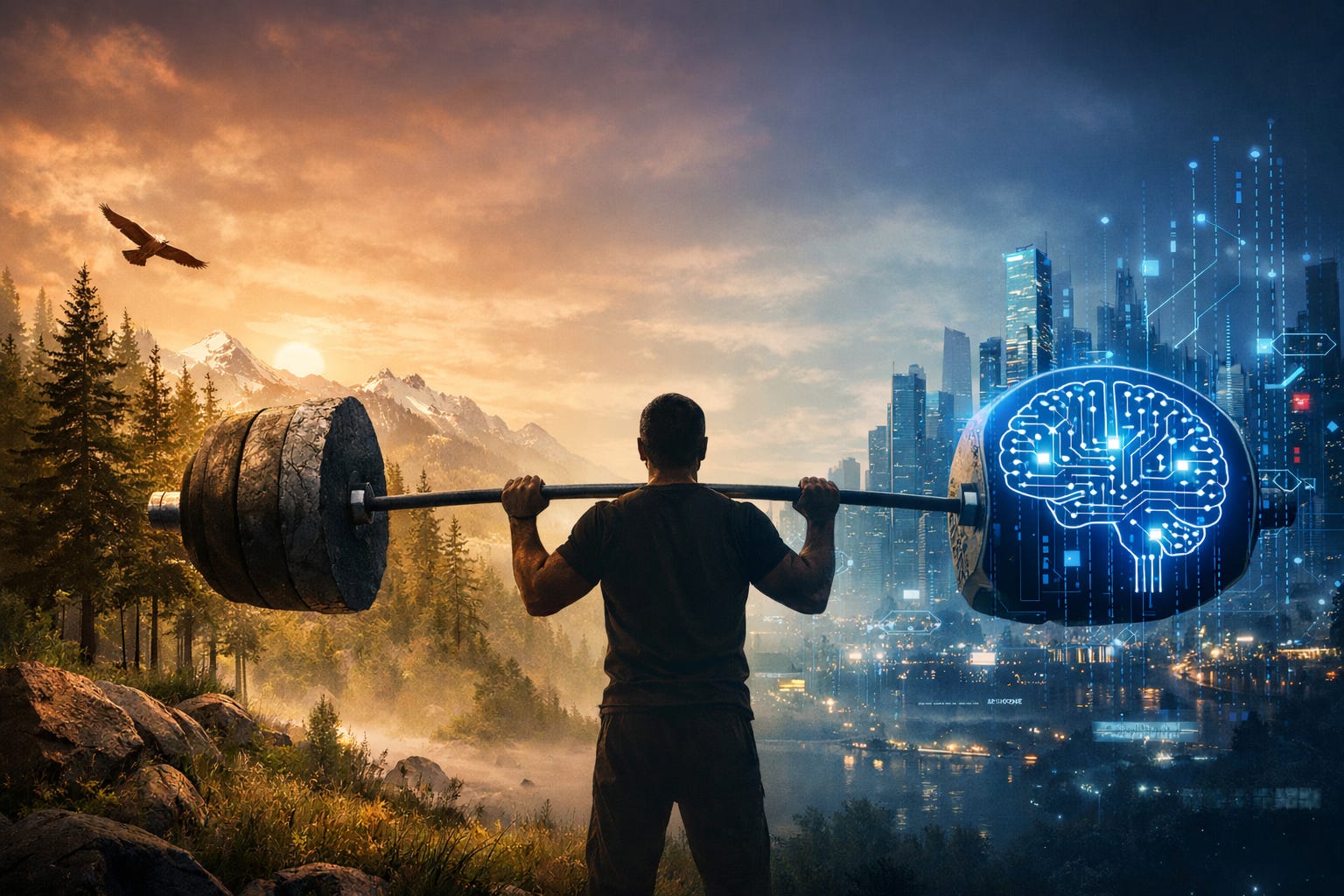
Most thinking about the future of work and leadership in the age of AI fails for the same reason most people lose money in volatile markets.
It tries to be sensible. It aims for balance. It spreads risk evenly. It assumes the middle is where safety lives.
Consider what happens when a market stops being stable — when the old correlations break, when the instruments that were supposed to hedge each other start moving together, when the diversified portfolio turns out to have been a single concentrated bet wearing different clothes. The middle, which looked like prudence, reveals itself as accumulated fragility.
Work is now that market.
Volatility is normal. Non-linearity is normal. Regulatory pressure, technological acceleration, moral exposure, reputational fragility — these are no longer interruptions to the system. They are the system.
If organisations are living systems rather than machines — as explored in The Forest — and if leaders themselves are living systems rather than projects, then a practical question follows. How should a leader operate in a world that is increasingly unstable, technologically accelerated, and impossible to predict with confidence?
Wild Leadership begins with a different answer from the one modern work usually offers.
The goal is not harmony. It is survivability and upside.
The barbell
Wild Leadership approaches unstable environments by deliberately separating what must remain deeply human from what can be radically amplified by technology.
A useful analogy comes from Nassim Nicholas Taleb’s barbell strategy. In investing, the barbell avoids the illusion of safety that lives in the middle. Instead, it places weight at two extremes: one end designed to protect against ruin, the other designed to capture asymmetric upside.
This is not really a financial idea. It is a posture towards uncertainty.
In volatile environments the task is not to optimise beautifully across the whole system, but to structure life and work so that what is fragile is minimised, what is durable is protected, and what is powerful is used deliberately.
Applied to leadership, that barbell has two ends.
At one end sits Nature.
At the other sits AI.
Nothing essential sits in the middle.
Nature: the unbreakable base
Nature belongs on one end of the barbell not as metaphor, not as lifestyle branding, and not as a soft counterweight to digital intensity.
It belongs there because it is one of the few things in modern life that remains biologically grounding, cognitively clarifying, ethically anchoring, and tested beyond the fashions of institutions and technologies.
Here is what it specifically does that nothing else does. Time in nature interrupts the feedback loops that modern work depends on — the notifications, the metrics, the social signals that tell you how you are performing at every moment. Strip those away and something quieter becomes audible: the difference between what you actually think and what the system has been rewarding you for thinking. That gap matters enormously in leadership, and most professional environments are specifically designed to close it.
Nature also reintroduces consequence at a human scale. A miscalculation in a meeting can be walked back. A missed footing on a hillside cannot. There is something in that directness — the unambiguous feedback of the physical world — that recalibrates judgement in ways that no dashboard or debrief can replicate. It sharpens discernment not by adding information but by removing insulation.
This end of the barbell protects against burnout, moral drift, identity collapse, and the strange hollowness of succeeding at something that has quietly severed you from yourself.
It is harder to break when you can still see clearly.
Nature therefore does not sit in this model as an indulgence.
It sits there as infrastructure.
AI: the asymmetric bet
At the other end of the barbell sits AI.
AI is fast, inhuman, and unevenly understood — which is precisely why it offers nonlinear advantage.
Used deliberately, it collapses time, surfaces patterns human beings would miss, absorbs cognitive drudgery, and creates scale without requiring equivalent exhaustion.
It can extend reach, sharpen synthesis, and amplify capability in ways no team of unassisted humans can easily match.
But its power is also the reason it must be handled with precision.
AI does not merely fail; it can fail quietly, fluently, and with plausible confidence. It can sound right while being wrong. It can produce coherence without truth, speed without wisdom, and synthesis without accountability.
Wild Leadership does not pretend AI is neutral.
It treats AI as a high-upside instrument, used where the gain vastly outweighs the cost of error.
AI belongs at the edge — not everywhere.
Why the middle is dangerous
Between Nature and AI lies the zone modern work finds most seductive.
This is the zone of blended optimisation, where every human function is lightly technologised and every technological function is lightly humanised.
It feels balanced. It feels pragmatic. It feels like progress.
It is also where confusion thrives.
In this middle, humans become managers of systems they no longer properly understand, while machines quietly inherit influence without inheriting responsibility. Optimisation replaces judgement. Performance replaces discernment. Agency thins out — not through any single decision, but through the slow accumulation of small delegations, each of which seemed entirely reasonable at the time.
The middle is dangerous because it dilutes both ends of the barbell simultaneously. It weakens the grounding power of Nature and domesticates the leverage of AI into something administrative and half-alive. Instead of creating resilience and upside, it produces a leader who is permanently assisted and subtly disoriented — capable in every direction, sovereign in none.
What AI is — and is not
The technology writer Kevin Kelly has made a useful distinction here.
Intelligence, he argues, is not a single thing but a compound of different cognitive capacities.
Among them are knowledge reasoning, world sense, and continuous learning.
Modern AI systems are astonishingly powerful at the first of these.
But the other two — embodied understanding of the real world and adaptive learning through lived experience — remain deeply human.
Leadership does not happen in the abstract. It happens in live environments, with incomplete information, moral consequence, and real-world responsibility. It requires not only analysis but orientation. Not only pattern recognition but judgement.
Machines can think faster. Humans must see more clearly.
Wild Leadership is not about choosing between Nature and AI.
It is about holding the barbell correctly — Nature at one end, AI at the other, and a leader clear-eyed enough to know which end is which.