
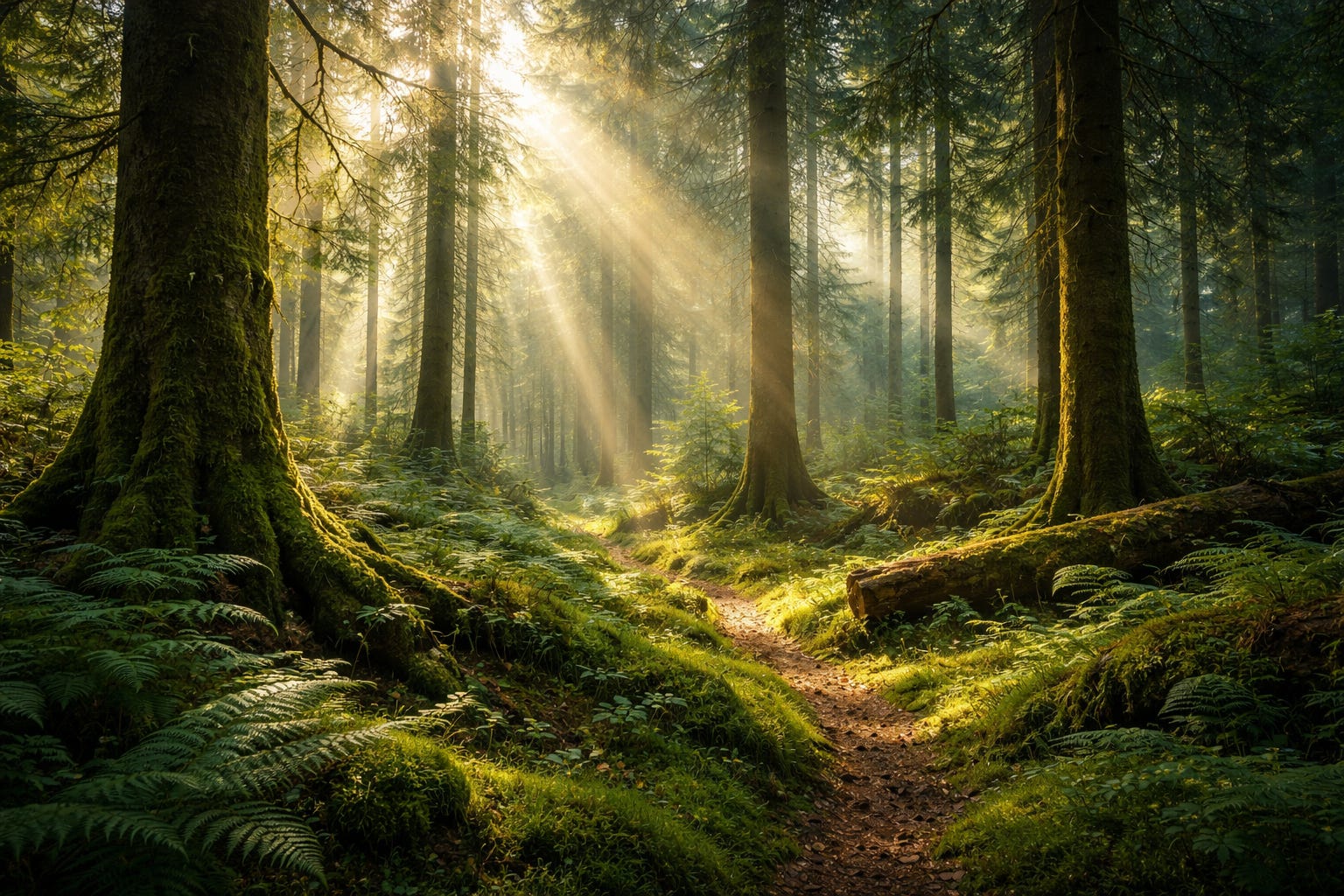
Most enduring ideas travel on a single image.
Not a framework. Not a model.
An image people can see.
For Wild Leadership, that image is simple:
The forest.
The Machine
For more than a century we have designed leadership as if organisations were machines.
The industrial age needed coordination, predictability and control, and management theory evolved to provide exactly that. In the early twentieth century, Frederick Winslow Taylor‘s scientific management broke work into timed, optimised tasks, treating organisations as systems to be engineered and measured. Henry Ford‘s real innovation was not the motor car but the assembly line — work broken into tiny, repeatable actions so that the entire factory could operate as a precisely engineered machine, with workers reduced to replaceable components within it.
Machines are predictable. Controllable. Optimisable. Linear.
If an organisation is a machine, the leader’s role becomes obvious: design the system, optimise the parts, eliminate inefficiency and control the outputs.
For decades this worldview shaped management thinking. It produced extraordinary progress.
But it also embedded a fundamental mistake.
Organisations are not machines. They are living systems.
Modern complexity science increasingly reaches the same conclusion: living systems cannot be tightly controlled. They evolve through relationships, feedback and adaptation. They cannot be commanded into health.
They must be cultivated.
The Forest
A forest is not controlled. Yet forests organise themselves.
Balance, resilience and renewal emerge without any central planner deciding where every tree should grow. A forest is adaptive, interconnected, evolving and partially unknowable. Its health depends far less on control than on conditions — soil, water, light and diversity. When those conditions are right, the system becomes generative. When they are disturbed — by drought, disease or pests such as bark beetles — the forest responds and rebalances.
Beneath the soil, trees are connected through fungal networks known as mycorrhiza. Through these networks they exchange nutrients and chemical signals — what is sometimes called the “Wood Wide Web.” Older “mother trees” can support younger trees by sending nutrients through these underground connections, helping new growth establish itself.
There is no central authority directing this vitality.
The forest thrives because the conditions allow life to organise itself.
Forestry — the deliberate stewardship of woodland — has been practised for thousands of years. At its best it is not an attempt to command the forest, but an act of regeneration: tending the conditions in which life can flourish.
This is the deeper task of leadership.
Why the Forest Matters
The forest metaphor resonates because similar ideas are emerging across multiple fields.
In economics, Kate Raworth‘s model of Doughnut Economics reframes prosperity as the ability to meet human needs while remaining within planetary boundaries. In ecology, Isabella Tree‘s rewilding work at the Knepp Estate in Sussex demonstrates what happens when control gives way to stewardship — when natural processes were allowed to return, ecosystems began to regenerate in surprising and remarkable ways.
Across economics and ecology, a similar insight is emerging:
Living systems thrive not through tighter control, but through stewardship of the conditions that allow life to organise itself.
Wild Leadership brings this insight directly into the practice of leadership.
What Changes When You See the Forest
Once the metaphor shifts, leadership changes with it. Not slightly. Fundamentally.
A forester does not control every tree. Their task is to protect the health of the ecosystem so that growth and renewal can occur naturally. Wild Leaders do the same. They focus less on controlling activity and more on shaping the environment in which people work. Clarity of purpose, trust between colleagues and shared responsibility become the soil in which performance grows.
The contrast between plantations and forests offers another lesson. A monoculture plantation can be highly efficient — but it is fragile. One disease, one drought, one shock, and the entire system can collapse. Forests endure because they are diverse. Wild Leaders therefore optimise not for perfect efficiency, but for resilience.
And just as mycorrhizal networks connect trees across the forest floor — carrying nutrients, signals and support — healthy organisations depend on relationships rather than hierarchies. The heroic individual is not the source of forest vitality. The network is.
Wild Leadership therefore emphasises networks, collaboration and ecosystems — not heroic individuals.
The Work of a Wild Leader
A Wild Leader does not attempt to control everything. They focus on something harder and more important.
They steward the conditions of the system.
This idea is not new. In the 1970s, Robert K. Greenleaf began describing leadership as stewardship — a responsibility to care for people and institutions so they can grow beyond the individuals currently leading them. Wild Leadership applies this idea directly.
In practice, it often begins with recognising how much of our instinct for control is driven by fear. When uncertainty rises, leaders frequently tighten their grip. But many of the things we try to control are precisely those where control is neither possible nor appropriate.
A wiser posture rests on a simple distinction:
You are responsible. But you are not in control.
Some things must be held tightly — ethics, values and the behaviours that define a culture. Other things must be held more lightly — especially how capable people solve problems and achieve results.
So ask yourself a simple question:
Where is my desire for control limiting the people around me?
And then, where possible, step aside.
The best leaders plant trees whose shade they will never sit under. Short-term thinking gives way to legacy thinking. Over time, the organisation becomes less like a machine and more like a forest — less fragile, more alive, and far more capable of renewal.
As the proverb reminds us: “The best time to plant a tree was twenty years ago. The second best time is now.”
Wild Leadership also requires recognising something more uncomfortable.
In the end, leadership is not the work of commanding the forest, but of caring for it.